Building Trustworthy AI
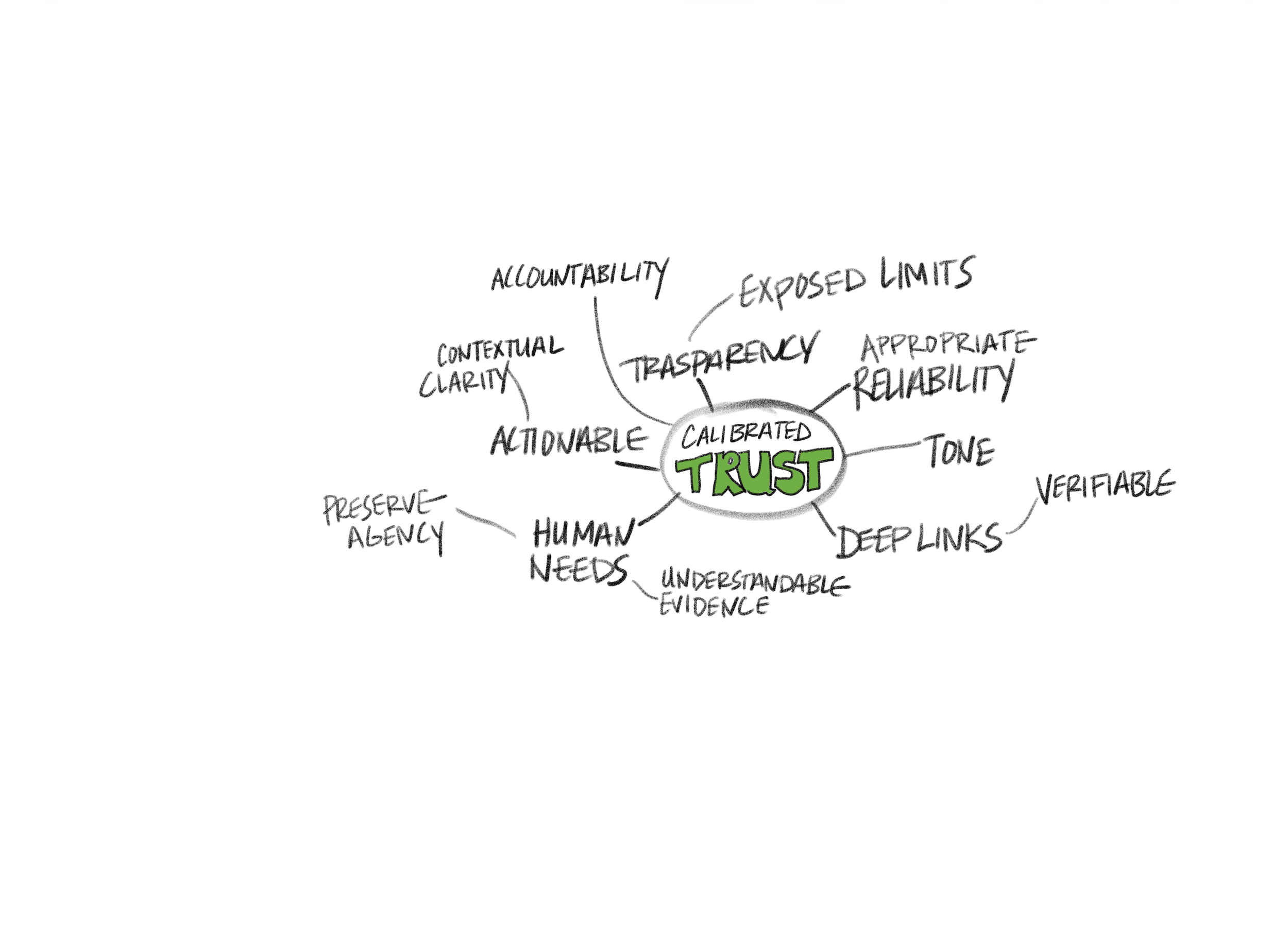
An AI knowledge assistant is only as good as what it knows and how it responds. I designed a method and structure that made an AI assistant’s responses worth trusting.
Project facts
Role: Service Design Lead, Strategist, hands-on builder
Context: An AI knowledge assistant for a large government organization.
Team: Design, data, development, and stakeholders
Methods: Subject matter expert discovery, scoped ingestion, golden sets, AI + HCD evaluation planning and testing
Year: 2025/2026
“ It was like filling an Olympic swimming pool one cup at a time, without structure or a strategy.”
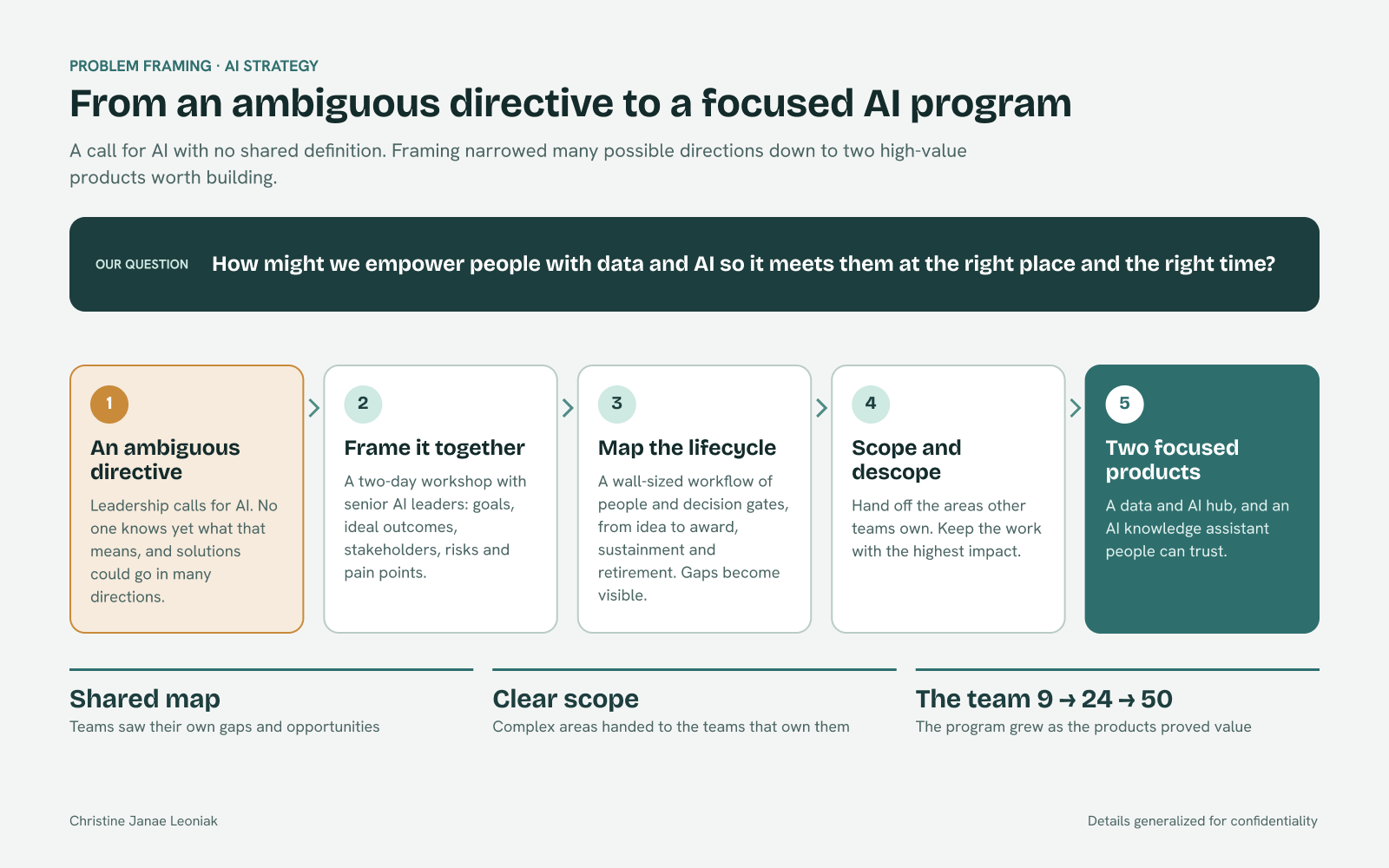
Details are generalized. The diagrams recreate my general methods with generic content.
How we got here
Leadership called for AI with no shared definition of what that meant. We framed the problem together with senior government AI leaders, mapped the full AI lifecycle, and narrowed many possible directions down to two high-value products: a data and AI hub, and an AI knowledge assistant. As the products proved their value, the team grew from 9 to 24 to 50. This case study is about the second product, and what it took to make its answers appropriately reliable and built on verifiable trust.
The challenge
The first use case for the assistant was scoped too big. Thousands of documents, scattered and unstructured, went in at once. Without scope, there was no way to build a golden set or test the user experience and AI responses in a meaningful way.
My role
I created the method we used to build and test the assistant, wrote the standard operating procedure from discovery to metrics, created the hierarchy that guides how the AI finds and references sources, and designed the test plans and facilitated AI + HCD user interviews, testing, and synthesis.
The Approach and Process
Scoped use cases
Instead of ingesting everything, I proposed use cases that could be completed end-to-end in a sprint or two:
Talk to experts to learn the real questions and which sources matter.
Ingest a scoped set of only the documents that the use case needs.
Build a golden set of questions, ideal answers, and sources to test against.
Test and measure, fix the gaps, then start the next use case.
Each use case connects to the others on an ecomap, so the value compounds. I wrote a one-page method, ran the first test case, and partnered with a data scientist on automated testing.
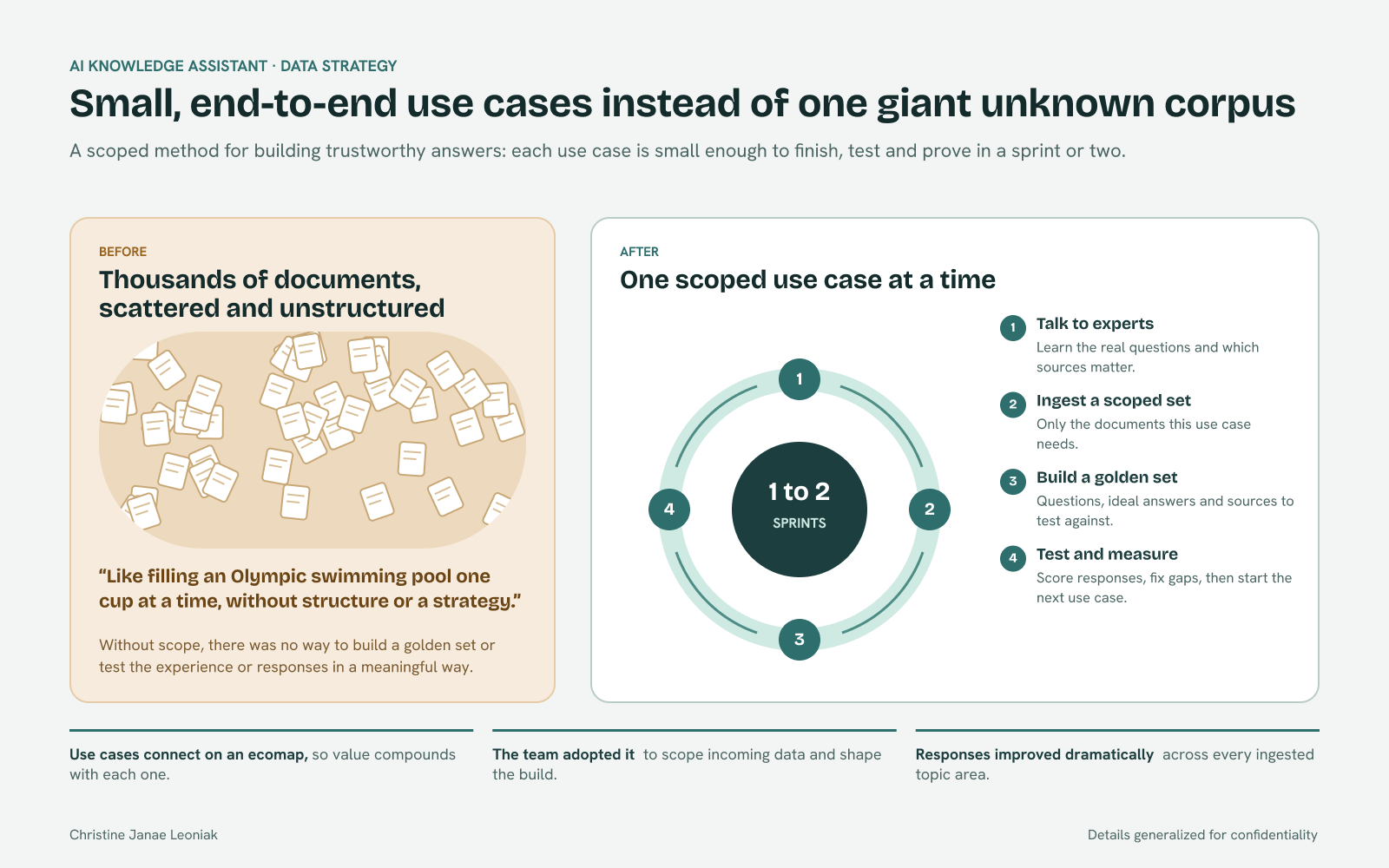
A high-level, generic concept recreated as an example of work completed
Earning buy-in
The method met pushback at every level at first. Asking a team to slow down and scope smaller can feel like going backward. I kept showing the evidence from each test case until the results spoke for themselves. Now the team uses the method to scope incoming data and shape the build.
A hierarchy the AI can reason with
I created a policy hierarchy that supports both directions people need:
Authority: higher tiers win when sources conflict.
Practical lookup: people start with the guidance they use every day, and the assistant traces up to the source of authority based on the goal.
The assistant's deep links now cite the most authoritative source while still answering practical, everyday questions.
Testing with real people
To learn whether people trusted the answers, I designed and built a scalable, scenario-based testing tool that captures reactions in the moment.
Outcome
Responses improved dramatically across every ingested topic area, in both accuracy and relevance.
Trustworthy citations: deep links point to the most authoritative source, even for practical, everyday questions.
Verification as a feature: when users check sources, it builds appropriate trust instead of signalling failure.
A method the team adopted to scope incoming data and shape the build.
Hidden value uncovered: the first demo surfaced a high-value agentic workflow projected to save thousands of hours annually.
Shared beyond the team: our product owner presented the method at a data and AI conference, where technical attendees called it clever.
What I learned
With AI, the hardest part isn't building. It's deciding what's worth building and how you'll know it's working. At the end of the day, AI should naturally integrate into workflows where it is most needed to support human decision-making. Starting small felt slower to some people, but every small, tested use case built trust: in the answers, in the method, and in the team.
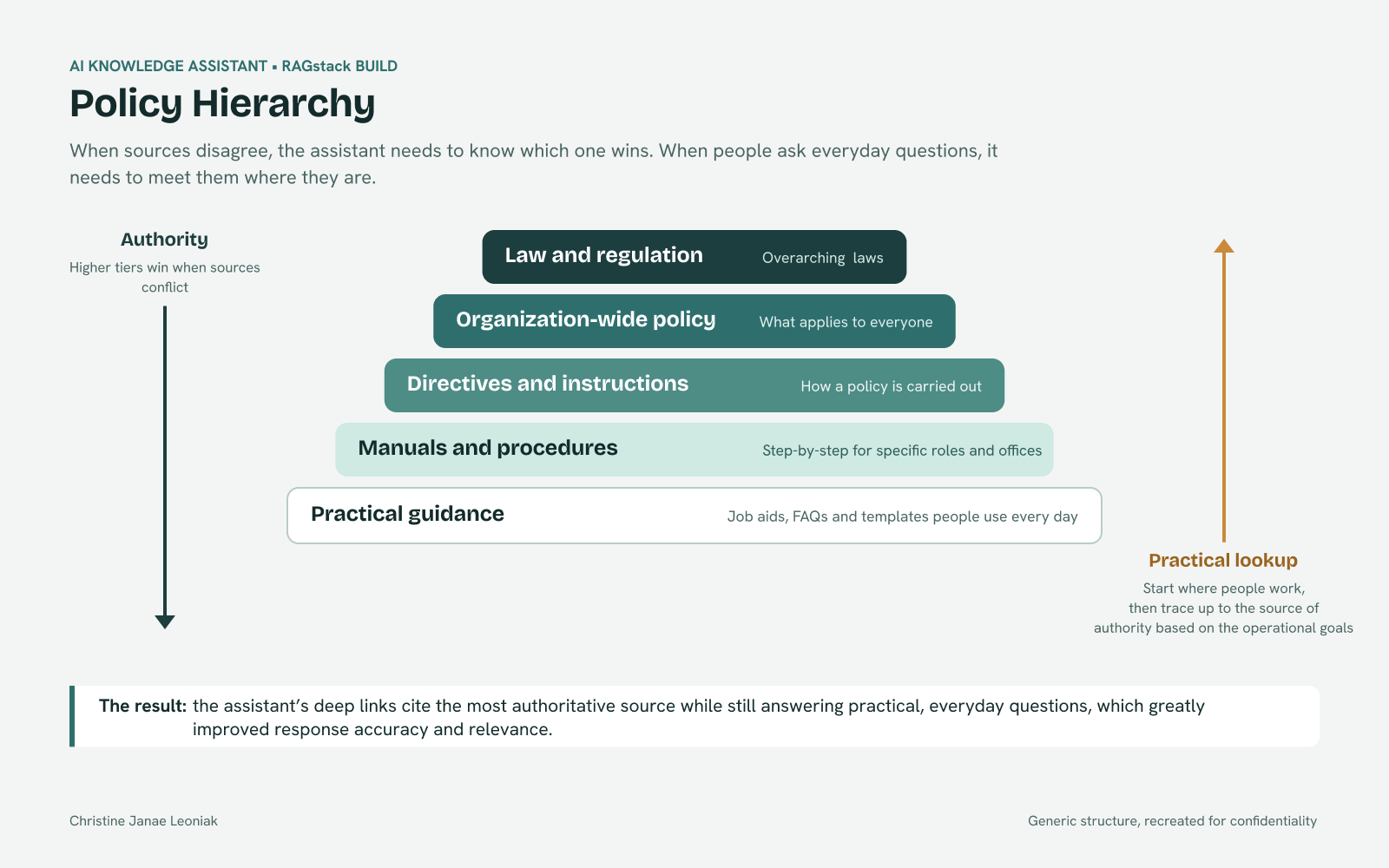
A generic recreation of the structure. Higher tiers win when sources conflict.