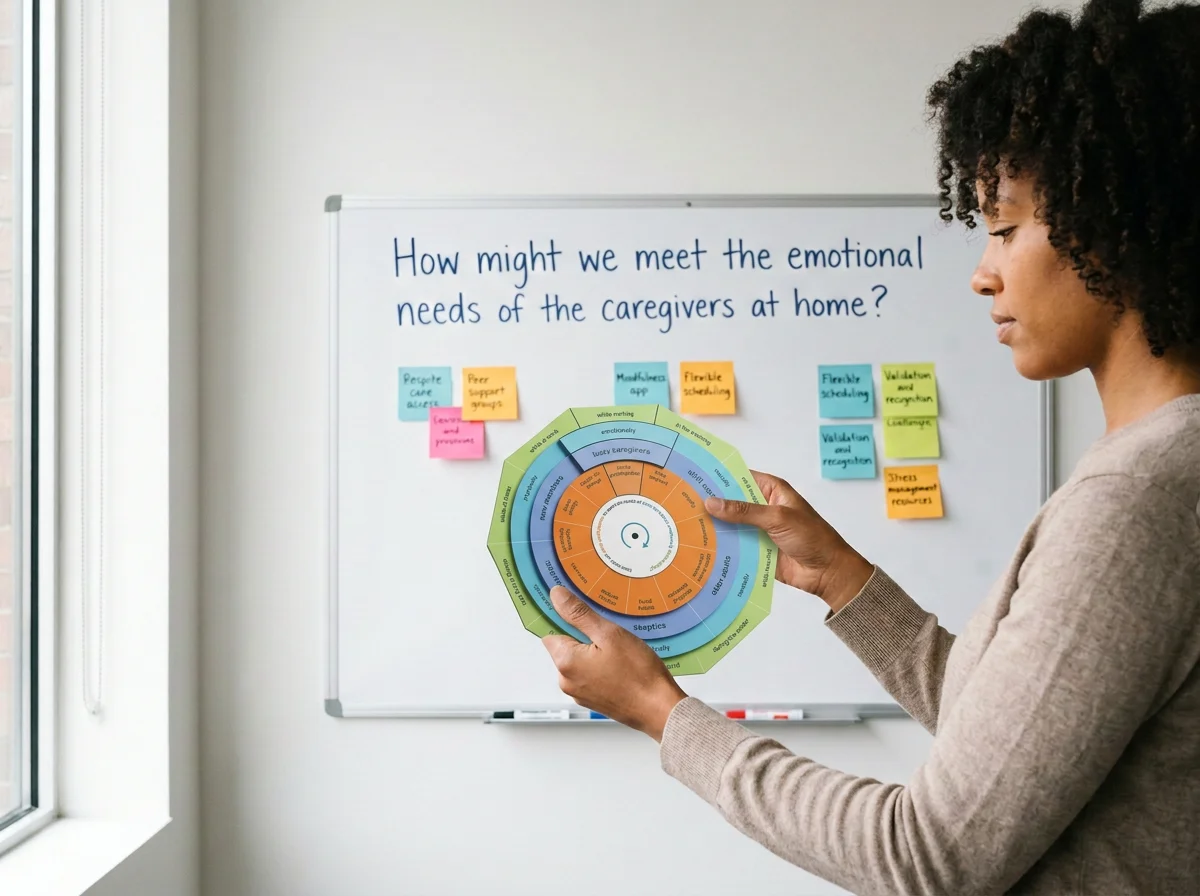
Challenge Question Tool
A paper tool I designed to assist Mayo Clinic teams write effective How might we questions. I’ve recently evolved it into an interactive tool that helps teams at the very start of a project and ask better questions before anyone reaches for a solution.
Project facts
Role: Designer-builder, inventor, facilitator
Context: Mayo Clinic’s Experience Project, now Bold. Forward. Unbound.
Original format: A paper wheel
Digital version: Claude Code, HTML, SVG, and JavaScript.
Year: 2009 and 2026
How might we questions help turn insights into opportunity areas, keeping the discussion focused on the right problem while still leaving room for creative ideas.
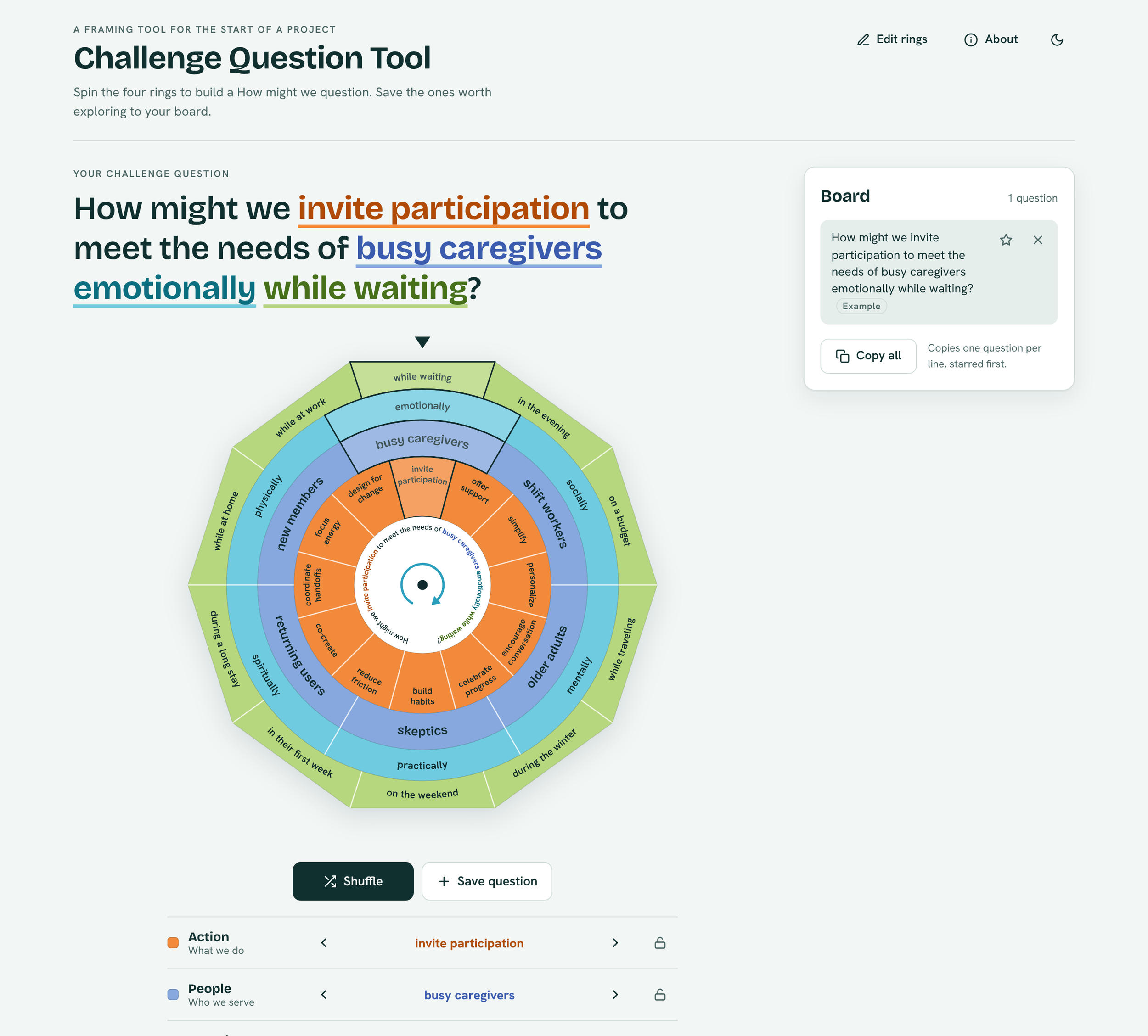
Digital version of the © 2026 Challenge Question Tool
The challenge
At the start of a big project, teams are under pressure to move fast. The first idea in the room often becomes the plan, before anyone has agreed on the problem, who it's for, or what need it serves.
The Mayo Experience Project was a large collaborative project between Mayo Clinic and the city of Rochester. At the earliest stage I introduced the ways to use How might we… questions.
Stand-alone guidance. I wanted to create a way for the teams to generate HMW questions even if I was not able to be present to facilitate.
Engaging and effective. In order to keep the team within the project scope but also allow for creative thinking I developed the Challenge Question Tool, so the teams could use project areas to populate the rings.
Tailored the to work. Because the wheel is customizable to the project, it has been a valuable tool to assist various teams I’ve consulted with.
My role
I designed and built the paper the Challenge Question Tool and have used it during facilitation and shared as a standalone brainstorm tool.
And now, years later, I rebuilt it as an interactive web tool so that I can share and use it in new and exciting ways on projects I lead.
The Approach and Process
Four tailored rings, one sharper question
The wheel turns a vague goal into a specific How might we question.
Each ring answers one part:
Action: what we do
People: who we serve
Experience: the dimension of need, such as emotionally or practically
Context: where or when it happens
Line up the rings and you get a question like…
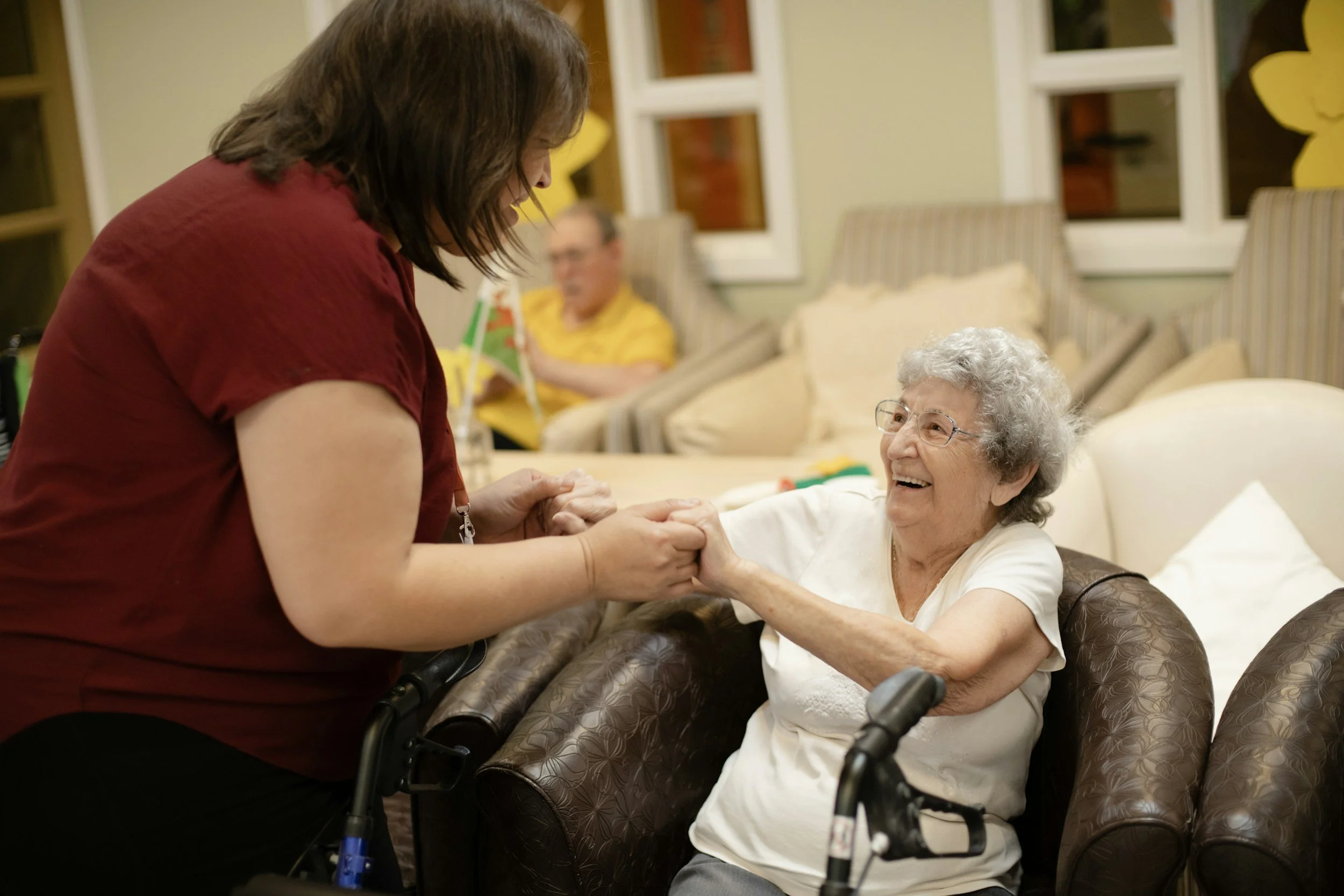
“How might we invite participation to meet the needs of professional caregivers emotionally while at work?”
Why a wheel
Turning a ring is quick and a little playful, which lowers the stakes. Leaders could try combinations they'd never have written down, compare them, and keep the ones worth exploring. The physical object also gave the room something to point at and talk about together.
Building the digital version
I rebuilt the wheel so it works in remote sessions and on a shared screen, and so anyone can fill it with words from their own project.
Spin and snap: drag a ring, tap a segment, or use the arrow keys. The live question updates as you turn.
Shuffle and lock: lock the ring you care about, such as People, then shuffle the rest for fresh combinations.
A board for the best questions: save, star and copy them as a list to bring into the next workshop.
Make it yours: edit any ring with your own project's words.
Accessible by design
Every action works by keyboard. Screen readers announce the updated question, the tool respects reduced-motion settings, and the text meets WCAG AA contrast.
Outcome
Sharper starting points: leaders framed the work around people and needs before discussing solutions.
A shared language: Action, People, Experience and Context gave teams a simple way to check whether a question was complete.
A tool that lasted: I still use this framing in workshops today, and the digital version makes it easy to run remotely.
What I learned
The quality of the answer depends on the quality of the question. A simple, tangible tool can change how a room of senior leaders thinks, because it makes slowing down feel like play instead of a delay.
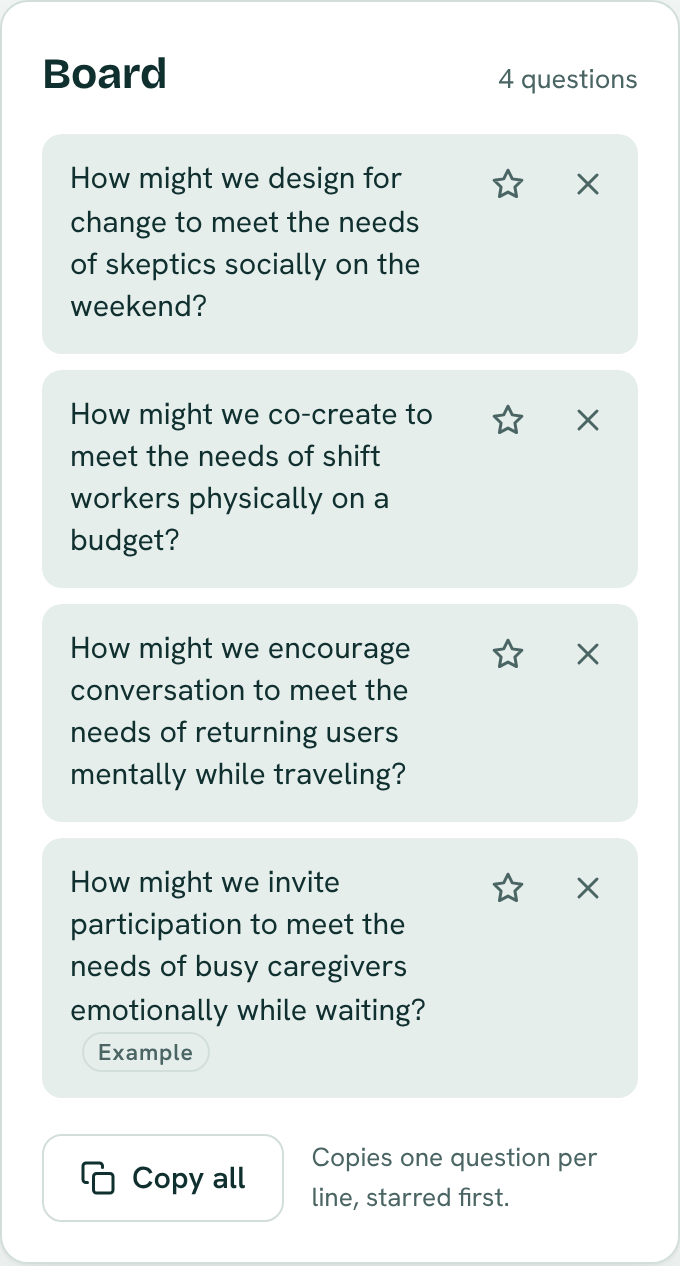
Save the How might we questions or statements on the Board for download or sharing.